Vision
Leveraging technology for a regenerative built environment.
We believe the success of a real-estate project should not be measured by financial indicators alone — the wellbeing of inhabitants and the impact on the planet belong on the balance sheet too. Our mission is to make that real.
Our mission
Tearing down the barriers to change
We want to believe that in the near future the success of a real-estate project will not be measured merely by financial indicators. Instead, the wellbeing of the inhabitants and the impact on the planet will also be added to the balance sheets as equally important key measures. These concepts, for now, are abstract in the daily lives of project developers, structural engineers and investors. Our mission is to change that.
We do believe that by leveraging technology and sharing knowledge, we can tear down some of the barriers in the way of this change. Technology enables the simplification and automation of many processes.
Current and upcoming regulations, slow and insufficient as they are, do help the transition and force the sector to invest in sustainability. Sustainable construction is not the responsibility of a single discipline. Owners, investors, architects, engineers, construction managers, BIM coordinators and legal departments — everyone has to work together to shape a more sustainable and equitable future. And this requires leadership.
We are also acutely aware of the limitations of sustainable design. This is where systems thinking and regenerative architecture come in. We want to be at the forefront of this approach as a technology provider. These are the concepts that shape the culture of our company and the range of services we provide.

Why it matters
The case for urgent action
Should global temperatures rise by 3°C by the end of the century, humanity would face catastrophic repercussions. Extreme weather and more than a metre of sea-level rise would be an existential threat to all of us. This underscores the vital necessity to meet the Paris Agreement's targets — a global action plan to limit global warming to well below 2°C, preferably to 1.5 degrees Celsius, compared to pre-industrial levels. Achieving these targets is not merely a policy issue, but an essential commitment for our collaborative survival and prosperity.
The construction industry is responsible for over a third of global CO₂ emissions, over a third of global energy expenditure and 40% of global waste. It is also currently off track to decarbonise by 2050. In the wake of new technologies, evolving regulations and green certifications, objective measurement and reporting of progress is key.
- >1/3
- Of global CO₂ emissions
- Attributable to the construction industry.
- 40%
- Of global waste
- Generated by the built environment.
- 1.5°C
- Paris Agreement target
- The warming limit we must collaboratively meet.
Beyond operational energy
The overlooked role of embodied energy
One of the main drivers of the net-zero transformation is regulation. Net zero simply means cutting emissions to close to zero, with any remaining emissions re-absorbed from the atmosphere by oceans and forests, for instance. In recent years many countries have been updating their national building energy codes to push for more sustainable developments.
These regulations cover a range of factors, from energy efficiency to indoor air quality and future wellbeing. International standards and certifications for green buildings, like LEED and BREEAM, are gathering momentum across the industry all around the world.
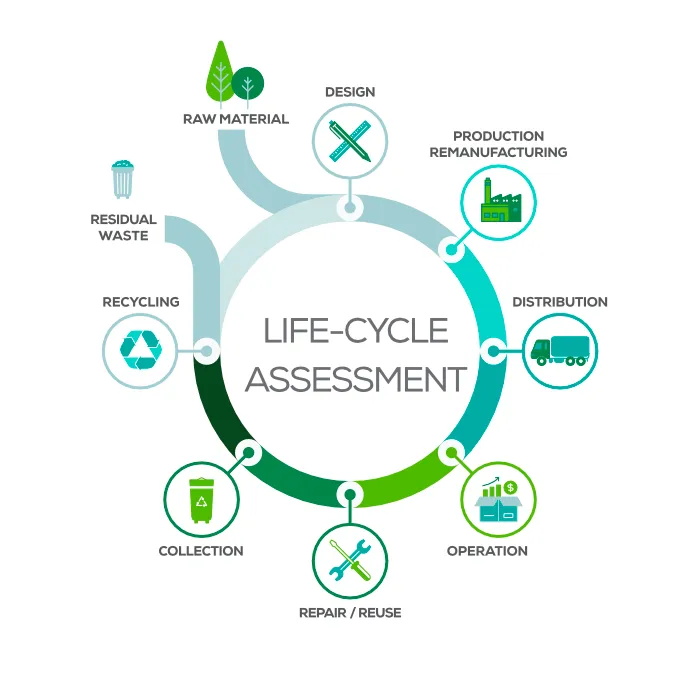
Yet an all-important aspect often remains overlooked: embodied energy. Existing net-zero definitions focus too much on operative energy. Renewable energy sources and good insulation are, by all means, important — but so is the amount of energy needed to erect the walls and produce the solar panels in the first place. Embodied energy is the total sum of all the energy needed to construct a building.
It can take up to 80 years for a new, energy-efficient building to overcome the climate impact of its own construction, compared to an average building. We want to emphasise the target of comparison — an average building. For it means there is still an impact on the environment, albeit lower than before.
Where we start
Focusing on concrete and steel
Initially, we focus on two building materials: concrete and steel. These two are responsible for most of the emissions. During the production of 1 tonne of cement, an equal amount of CO₂ is created as a by-product. For steel, it is 1.8 tonnes of CO₂ for every tonne produced.
Learn more →Ready to build zero-impact?
Tell us about your project and discover how AI-driven take-offs, life-cycle assessment and certification can accelerate your sustainability goals.
Get in touch